


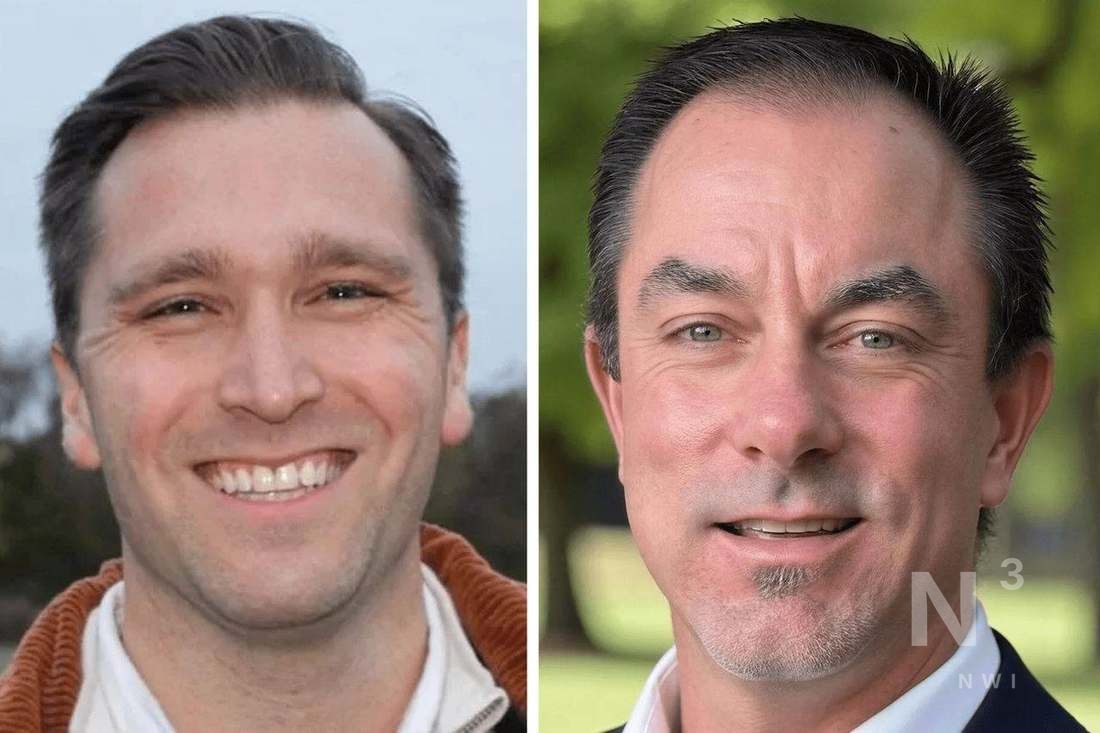
HIGHLAND, Ind. — Northwest Indiana Republican primary voters removed two sitting state senators who opposed President Donald Trump’s mid-decade congressional redistricting drive, elevating St. John’s Trevor De Vries and DeMotte’s James “Jay” Starkey and resetting the Region’s November Senate map.
Key facts
| Race | Result |
|---|---|
| District 1 | De Vries ~75% / Dernulc ~23% (Trump-endorsed challenger) |
| District 6 | Starkey ~57% / Niemeyer ~43% |
| Statewide | At least six GOP senators who voted “no” on maps defeated (Capital Chronicle) |
| Ad spend | More than $8 million in Senate primary contests (AP via Post-Tribune) |
| November | De Vries vs Houldieson (D); Starkey vs Holley (D) |
With all precincts reporting, Sen. Dan Dernulc, R-Highland, trailed Trump-endorsed De Vries about 23% to 75%, while Sen. Rick Niemeyer, R-Lowell, lost to Starkey about 43% to 57%, the Post-Tribune reported May 6. Tallies remained unofficial until the Lake County Election Board’s May 15 canvass. The Times of Northwest Indiana framed the results as punishment for senators who refused Trump’s strategy to redraw Indiana’s nine U.S. House districts after the December Senate defeat of the maps.
District 1 covers Dyer, Griffith, Highland, Merrillville, St. John, and Schererville. District 6 includes south Lake County and all or part of Newton, Jasper, and Benton counties, The Times reported. Trump endorsed primary challengers to seven sitting senators on Truth Social, including De Vries against Dernulc; Starkey did not receive a Trump endorsement but ran a visible TV and mail campaign, the Post-Tribune said.
“God provided the results,” De Vries told the Post-Tribune the morning after. He said affordability is his top November focus and that doorstep conversations centered on utility bills. “The number one conversation we had on a daily basis was regarding things like NIPSCO and the concerns on how ratepayers are subsidizing these big corporations,” he said. De Vries argued the redistricting vote “woke a lot of people up” to Statehouse complacency. Dernulc did not respond to Post-Tribune comment requests.
Starkey said voters wanted new Republican legislators and responded to messages on high energy costs, the Indiana Utility Regulatory Commission, property taxes, and corporate benefits. “People were ready for change, and the voters spoke,” he said. Niemeyer, facing a GOP primary challenger for the first time since 2014, said he voted against the maps because they did not come from party leadership and because he did not understand why the 1st Congressional District was divided. “The voters voted, and that’s what happened. That’s how the system works,” Niemeyer told the Post-Tribune.
November matchups are set. Starkey faces Democrat Kate-Lynn Holley, who ran unopposed. “Nothing really changes if we keep the same people in the same positions,” Holley said in an April interview quoted by the Post-Tribune. “People deserve choice.” In District 1, Democrat Scott Houldieson was unchallenged and drew 8,171 primary votes compared with 9,034 combined for the three Republicans — arithmetic the Post-Tribune flagged as potentially tight. The seat was a Democratic stronghold for decades under Sen. Frank Mrvan, D-Hammond, until post-2020 maps shifted it south and Dernulc won in 2022.
The Region’s ousters sit inside a statewide realignment. Indiana Capital Chronicle reported that at least six GOP senators who voted against the December maps lost, after a 21–19 Republican split inside the 31–19 Senate rejection. Gov. Mike Braun said it was too late to redraw maps for 2026 but called the Senate a “roadblock” and urged replacing Senate President Pro Tem Rodric Bray, labeling the chamber’s default posture a “wet blanket.” Attorney General Todd Rokita said voters “took care of business” and “showed that Trump was the head of the party.”
Gary’s Common Council had already unanimously opposed mid-cycle redistricting, Capital B Gary reported, with Councilman Darren Washington calling the effort “unacceptable” and Council President Lori Latham branding it “an attempt to cheat before the midterms.” Immediate stakes: two Trump-aligned nominees, two Democratic alternatives, and a Senate delegation remade by the cost of saying no to a presidential map.